
Ash Wednesday, the start of the Lenten season for Western Christians—the 40 days (or 46 if you count weekends) leading up to Easter.... is also an exercise in visibility.


[KQED in San Francisco will broadcast at 10pm PT, and WTTW in Chicago at 9pm CT; below is a list of some larger media markets where the times are different.].
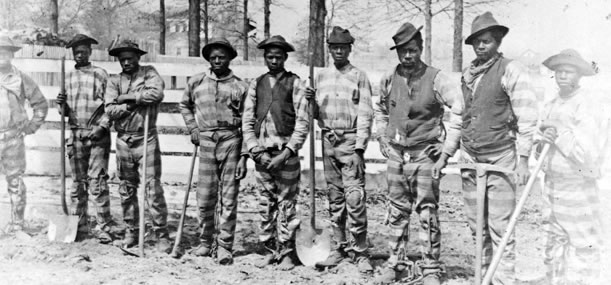
This film vividly presents the little-known story of thewidescale reimposition of actual slavery in the South, after Reconstruction, which reached its height in the early 20th Century and continued -- with its condoning by the US Dept. of Justice -- until Pearl Harbor. |The consequences for African-American families and communities in the South were horrific.This severe abuse represented a form of judicial, political and economic terrorism which still reverberates in American politics.The film concentrates on a few stories of the hundreds of thousands of African-American men dragged into the “convict-leasing system” – and assigned to coal mines, brick factories, farming and other industrial-sized enterprises, with murderous consequences for them and incredible profits for the corporations which used them. In coal mining, the slave labor system was explicitly used to stop one of the most important strikes in Southern history – the UMWA’s effort to stop convict leasing at the US Steel mines in Birmingham. That strike was smashed by the Alabama state militia in an incident every bit as brutal as the well-known incident in Ludlow, CO.

Photo by Yogesh Mhatre
Most of this report was researched and written by Weiping Li, Mera Szendro Bok, and edited by Sarah Myers.
Netizens around the world took collective action with a mass Internet blackout on January 18 to protest the United States' Stop Online Piracy Act (SOPA) and the Protect IP Act, which, in its effort to enforce copyright online, would have compelled Internet service providers and platforms to monitor and censor their users or risk being blocked or penalized in the United States, and would have weakened the Internet's domain name system, among other things. Global Voices and Global Voices Advocacy participated in the protest along with over 7,000 websites, including Mozilla, Wikipedia, Reddit, Flickr, TwitPic, Boing Boing. Advocacy groups including Public Knowledge and Free Press blacked out their sites and posted information about how to get involved in the fight against these bills.
Many protest websites tracked the bill's Congressional Representatives' supporters, ultimately pressuring many representatives to withdraw their support. In the end, Congressman Lamar Smith, SOPA's sponsor, pulled the bill and said it would not go to a vote until “issues are addressed”. Inspired by the American protests, netizens took action around the world on digital rights, including Chinese activists. An article in Ars Technica neatly summed up the impact of the legislation on the rest of the world.
After SOPA and PIPA’s Death
Now it seems that SOPA and PIPA are dead. But concerns about illegal file-sharing persist, and commentators warn that similar bills may be reincarnated. Ben Huh, The CEO of I Can Has Cheezburger?, states that we still have more work to do in order to defend Internet freedom and sustain the engine of netizen mobilization. His opinions echo an article by Alex Howard on O’Reilly Radar, which argues that citizens need to band together to work out alternatives to SOPA. Internet and Politics guru Micah Sifry discusses the broader political environment that produced the bills, and the need for Internet companies and netizens to work for political reform. Internet law Professor Yochai Benkler offers seven lessons and four proposals on where we go from here.
Censorship
Major Chinese cities including Beijing, Shanghai, Tianjin, Guangzhou, and Shenzhen have enforced a registration system that requires users to register their real name on Weibo, the prominent Chinese microblog. Although the new regulation has been widely criticized by Chinese netizens, including Pony Ma (Ma Hauteng), the founder of Chinese Internet service company Tencent, the Chinese authority still plans to implement the rule in other parts of the country.
In contrast, South Korea, which adopted online real-name registration in 2007, has taken steps to abandon the practice. Having faced criticisms of infringing freedom of expression and concerns over hacking, some Internet companies have decided to stop asking customers’ resident numbers, and the Korea Communications Commission is also planning to abandon the real-name registration requirement.
Surveillance
The Argentinean government is launching a program to build a national biometric service named “the Federal System of Biometric Identification (SIBIOS)“. This system combines Argentinean citizens’ biometric information with other databases and be used by law enforcement. According to Katitza Rodriguez’s report for Global Voices Advocacy, the information gathered through the SIBIOS system would include not only biometric identifiers but also “an individual's digital image, civil status, blood type, and key background information”. The program has raised serious concerns over the government’s unrestrained power to surveil its people.
Sprint has promised to remove CarrierIQ tracking software from the cell phones using its network, making good on its word to improve security for its users.
To fight against the government’s intrusion into netizens’ personal Internet information, EFF and ACLU filed an appeal to challenge the U.S. district court’s decision to refuse disclosure of all orders in the Twitter/Wikileaks case.
A hacked document revealing that RIM, Nokia, and Apple provided the Indian government backdoor access to users’ communications may be fake. The three companies and security company Symantec have argued this document was full of incorrect information, and is not from the Indian directorate general of military intelligence.
Netizen activism
A recent study found that in Colombia, the Internet is changing the media landscape. The research pointed out that online journalism emphasizes local perspectives and incorporates more interaction with readers.
According to the Statistical Report on Internet Development published by the China Internet Network Information Center (CNNIC), the number of Chinese Internet users hit 513 million in 2011, which is almost equivalent to the number of Twitter users. Half of the the 513 million netizens are microblog users.
Is citizen journalism rising in China? Maybe. With the prevalence of digital cameras, videos, and social media, more and more Chinese citizens shoot newsworthy events and are uploading the clips to websites. Media scholars expect this trend may promote societal progress.
Want to know more about hacktivists who often hit the Internet activism headlines? This documentary may provide the audience with insight into hacktivist group Anomymous.
Sovereigns of Cyberspace
Twitter has announced that it now has the capability to restrict content from appearing in certain countries. The company says this will allow it to comply with local laws in different countries without having to remove content globally. When content is restricted in this way, the action will be reported to users through the Chilling Effects website.
Twitter also acquired a start-up company which has developed a service to summarize social media content and solve the information-overload problem.
Google announcement of an “upgrade” of its privacy policy and terms of service that integrates user information across its search engine, GMail, YouTube and its 57 other services stirred criticism from privacy groups and some members of Congress. In the weeks before the announcement, Google launched a “Good to Know” campaign to educate the public on how to stay safe online. Meanwhile, Google is also readjusting its China business strategy. Setting its past confrontations with the Chinese government over censorship aside, Google has decided not to miss out on this big market and plans to introduce more services.
And much more: read the complete report at Netizen Report: Uprising EditionPeter Constantine in the New York Times Book Review writes
Among the most surprising qualities of “Babel No More,” Michael Erard’s globe-trekking adventure in search of the world’s virtuosos of language learning, is that a book dealing with language acquisition and polyglot linguistics can be so gripping. But indeed it is — part travelogue, part science lesson, part intellectual investigation, it is an entertaining, informative survey of some of the most fascinating polyglots of our time.
How is it, Erard asks, that certain people are able to accumulate what for the average person is a daunting number of languages? What are the secrets of polyglots who can master 6, 26, 96 languages? What are their quirks and attitudes? Are their brains wired differently from ours?
Erard, a journalist who writes frequently on language and whose previous book was “Um . . . : Slips, Stumbles, and Verbal Blunders, and What They Mean,” begins by visiting Bologna, Italy, the hometown of one of history’s most distinguished polyglots, the 19th-century cardinal Giuseppe Mezzofanti. The cardinal is said to have known 45, 50, 58 or even more languages, depending on whom you ask. Victorian travelers who met him at ecclesiastical banquets reported that he affably conversed in all directions with foreign visitors in languages ranging from French, German and Arabic to Algonquin and “Californian.” (Lord Byron, who challenged the cardinal to a multilingual contest of profanities, was not only summarily defeated but walked away from the contest having learned a number of new Cockney gibes.)
The Art of Mastering Many Tongues, 3 Quarks Daily. More here.


